Saturday, February 5, 2011

Gmail protects me from myself

The lists of common-sense things to do to protect your computer have been around for years: choose a secure password, don't download suspicious software, constantly run and update virus protection, protect yourself from spy ware.

Despite knowing this advice, I haven't always followed it. Sometimes I download stuff that I haven't checked thoroughly, or I have a simple password to access things I don't use very often. And, for all of my online life I haven't had a problem. Until recently.

Somehow my email was compromised and everyone on my contact list was sent a link to some strange Russian porn site.

That should be the end of it...now my email is done for, and I've got to come up with another address to use. But no...Google sniffed out the problem and did a few clever things to help protect me.

First, they noticed the account was sending out a lot of messages, and stopped the account from being able to send anything out. Then, in order for me to log in again, I had to jump through a lot of hoops (asking questions about what I put down as my personal information) then sent a text message to the number I had listed as my phone number and made me enter it in.

Then, once I had regained access they encouraged me to set up 2-step access. I've always been interested in information security, and the nerdy things smart people can do to keep information safe. The US intelligence agencies use special rooms called SCIFs (pronounced skiffs) to discuss classified information and have specially configured blackberries that allow for access to classified email systems. Google, of course, can't reconfigure the equipment we use, but they can take
advantage of the equipment we have.

Once you're forced to change your password, Google asks you input information about your phone, and if it's a blackberry, iPhone
or other certain smart phones it encourages you to download a program that generates a random 6 digit number every minute.

To configure the program, you take a picture of a QR code (like the one shown to the right) with your phone, and the software translates the image into the information it needs to assign the random numbers to your specific account.

Then, once your phone is configured, you need to enter the 6 digit code the first time you log in to your account. Google recognizes the computers you use on a regular basis, and only makes you put in the code about once a month once it's configured.

Then in a final turn of brilliance, they find 2 ways to help you access your email should you phone go missing. First they ask for a backup number they could send the access information to (as a text message or even a voice mail) and then they employ a form of encryption developed almost a hundred years ago: the one time pad.

US intelligence agencies needed a way to communicate secret information, and a guy named Gilbert who worked for AT&T had the idea of using a randomly generated series of numbers to encrypt messages. The sender would have a list of numbers on a small pad of paper and would shift each letter down the alphabet a number of places. The recipient would have the same list of numbers, and could decipher the message by undoing the change the sender made. After each message, you destroy the page you used and sue the next list of numbers for the next message.

Since the only two people who know how many positions each letter was shifted, and the number is random each time it's virtually impossible to crack. Google takes advantage of this, and as a last resort, if you lose access to your account you are given a list of 10 numbers you are supposed to keep in your wallet. If you don't have you phone, and the other techniques don't work, you use this one time pad to get back in to your account. Clever right?

I'm relieved the geniuses at Google protected me from my, well, dunceness.

Saturday, January 22, 2011

My favorite carnivorous water-borne mammal-themed product

I'm a klutz.

I think klutz-dom is much like having a bad sense of direction, or being hopelessly bad at math: it's important to just look deep within yourself, see the truth and accept it.

Some people try to fool themselves into thinking it's not true. You know this guy: he ignores the map or GPS and refuses to stop for directions, only to end up hopelessly lost and an hour late...or he swears he can split the bill for the whole table in his head, but consistent raised eyebrows around the table lead to someone breaking out the calculator on their phone.

I was the same way with my klutziness. I even went out for the basketball team in 8th grade, hoping that my diminutive height would be outweighed by hard work and determination. Unfortunately...there is no amount of determination that can undo the embarrassment of constantly dribbling the ball off your foot during tryouts.

So, I've come to accept my klutzitude. And part of that acceptance led me to purchase an OtterBox.

The OtterBox is extra-ferocious defense for your iPhone, iPad, or any other smart phone or fragile piece of electronic equipment you keep in your pocket. The makers, however, are very careful (for legal reasons I'm certain) to say that it's not indestructible.

That won't stop me from saying it, though: its indestructible! It's waterproof, and dirt proof, of course, but also shatterproof! I've dropped my iPhone 3GS on the tile bathroom floor multiple times with not even a ding. I've even thrown my phone to someone in a parking lot, only to have them miss that catch and drop it...phone's fine.

They have several levels of protection for your phone, from the low-end slinky all-rubber number to "The Defender" - a combination of silicone, hard plastic, and a clear plastic sheet that keeps your phone completely protected while still allowing you access to all the ports and jacks and buttons you need to use.

The only thing I haven't done to my OtterBox yet is throw it into an active volcano...though, that's probably good for a couple reasons. I'm pretty sure it won't protect my phone (I mean...the thing is only rubber, not tiles from the space shuttle) and I may just lose my balance and fall in if I got that close to a volcano.

I am a klutz after all.

Saturday, January 8, 2011

My love affair with Slingbox

Guys who love gadgets are everywhere. There's nothing particularly special or interesting about a guy who loves the latest technology: they keep things like Wired magazine or this week's CES in business. By my passion for Slingbox is a bit deeper than just geeky interest - it's a downright love affair.

Slingbox is a small black and red box about the size of a copy of Atlas Shrugged that streams video from your TV or cable box to the Internet. And, of course they have an application for the iPhone.

My job in TV News gives me a few key uses for it. For example, part of my responsibility is knowing what we (and our competition) covered in the 11pm newscasts the night before. Slingbox allows me to watch those newscasts that I have saved on my cable box with my iPhone while I'm running on the treadmill at the gym. I can even stream them in the car and listen to them as I drive in to work.

The Slingbox gives our newsroom a vital capability as well: we can use it to stream our on-air feed to CNN during breaking news, which frees up other transmission resources for live feeds and takes the burden off our team to worry about feeding the networks and instead allows us to focus more on covering the story.

I'm not alone - in terms of utility in our newsroom the consultants, reporters and news director love it too. The consultants can use it in conjunction with minute-by-minute reports of who tuned in and out during the newscasts to try to draw connections between what stories were on air when people turned us off. The news director and executive producers can see how certain blocks flowed just after they went on the air, and whether there were problems with commercial breaks. Our reporters use it to see to watch previous newscasts and see how their live shots looked on-air and how they looked in the two-box with the anchors.

My favorite use for it is in the rare event we get beat on a story, we can see what our competition had that we didn't. Let's say they had an interview with a friend or relative we were unable to find - in the past you had to hope they'd re-run the piece or post the story to their website so you could start chasing that lead. Now we can pull their piece up instantly, jot down the super, and start chasing!

Of course, it's nice outside of work: if I'm stuck at the airport, or waiting for my car to get fixed I watch saved items on the DVR, or even watch live sports. Netflix and Hulu are nice and all...but there's no other way to watch a live sporting event on your phone without a Slingbox.

I can't think of anything else that's red and black that makes my heart race...unless it UGA victory on the football field.

Tuesday, December 21, 2010

The Live Trucks are Disappearing

The technology to transmit live video through the air has existed for decades. Until recently it's taken millions in infrastructure, microwave towers, satellite dishes, and specialized training. Local TV newsrooms continue to use digital microwave and satellite trucks to get live video back to the station, but rapid improvements have started to change the game.

Earlier this year, our newsroom to a live Skype shot to air. With the help of a MacBook Pro and a high quality camera, the video was really close to broadcast quality...but it still relied on thousands of dollars in camera and computer equipment.

Sometimes, though, broadcast quality isn't as important as live...and viewers are OK with lower quality video if there's a good reason for the lower quality. Look at the VTech camera phone video - the quality wasn't great, but because of the significance of the tape it didn't matter. Think of all the crazy surveillance tape you see on television...tape that conveys immediacy or tells a story is more important than perfect quality.

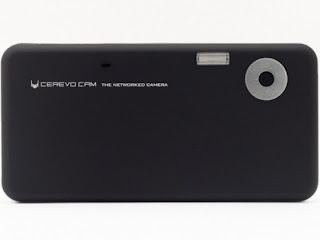
That's where UStream comes in...UStream allows regular people to stream live video from mobile devices. They even have a free application to stream video from the iPhone. Sometimes, though, your field crews don't have an iPhone or they don't have the opportunity to configure an account just to cover breaking news. That's where the recently released Cerevo cam stands out.

Cerevo Cam is a Japanese product that allows to stream video to UStream with just a couple quick button strokes. I recently had the opportunity to play with and configure one of these cameras.

It wasn't an easy process - the thing only exists in Japan, and though the menus on the camera itself can be displayed in English (after some blind tinkering with options) it has to be configured using the Japanese-only website. (Big thanks to Google Translate for help on this...obviously).

Once you enter the information for the Wi-Fi network you're currently using, the website creates a QR code. By taking a picture of the QR code, the camera configures itself to automatically submit pictures to the Cerevo website...and with a little more configuration you can have the thing feed directly to the UStream website.

Though I appreciate the simplicity designed into the camera (once configured) it seems a little unnecessary. The iPhone 3Gs and iPhone 4 have the capability to transmit video to the UStream website, and it doesn't require extra hardware. In addition, the Cerevo camera doesn't work unless there's a Wi-Fi hotspot, so to use these in the field we need to deploy them with a mobile Wi-Fi hotspot.

We still use live trucks...but who knows how much longer that could last. Incremental developments like UStream, Cerevo Cam, Streambox and the Livestream livepack are all slowly pushing us to a day where the cost for full HD streaming live transmission drops through the basement.


Monday, October 5, 2009

The Teaching Company

Remember sleeping through lectures in college?

OK, I didn't ever do that (cutting class, though - different story).\. Regardless, The Teaching Company found a way to learn about something new and ensure you get a quality experience. They travel the country visiting the top colleges and universities in the country, auditing the most popular, talked-about classes, reviewing professors, and then making those lectures available on CD or DVD.

I've been doing a lot of driving lately (over the past 4 months I've driven at least 5,000 miles) and finding some way to stay entertained on those long road trips can be tricky...but not with The Teaching Company. I've tried four courses so far (borrowed from friends), and each had something valuable to offer (even if it wasn't intentional).

The first was about Game Theory and Decision Making. I'd briefly studied some game theory in college statistics, and thought I'd appreciate the subject as it comes to decision making in my new role as a manager. However, I'd forgotten to take into account that appreciating a board full of equations and decision trees is impossible when you only have the audio version. After about 6 or 7 lessons I found myself getting lost quickly...and soon gave up.

The second was about how to appreciate the world's great music. I figured this would be great: it's well reviewed by other people who've listened to it, and I sure won't have the problem of needing to see the chalkboard this time. However, I was soon reminded that I simply don't care enough about the subtle differences of fugue among the great French composers. It got to be a little too much detail on a subject I just couldn't force myself to want that much detail on.

My next was Argumentation. The lecturer points out right away: THIS IS NOT ABOUT HOW TO WIN AN ARGUMENT. I was a little disappointed (haha), but rode through it, and I'm glad I have. It gets a bit detailed, but lecturer immediately backs off and explains terms when he gets too mired in detail, and it's been interesting to apply the technical framework of argumentation to the daily pitches I get on the phone, in email and in the story meeting. I've also been listening to it on the way in to work, and it's helped get me focused and thinking while I'm on my way in. I'm almost done too: I'm on lecture 19 of 24.

My favorite, without a doubt, has to be Understanding Linguistics: The Science of Language by John McWhorter! Every couple of days I'd come away from one of his lecture with some new fact about how linguistics work, or why it's easier for children to learn language than adults, or whether there's languages that use sounds we don't make in ours (btw, yes...check out Kabardian...they have 48 consonants and only two vowels, and it's one of the most complex things ever!) This guy somehow found a way to make an imposing and obscure field seem so clear and logical, and especially entertaining. He's another one of those scary smart people in the world that have a gift for being able to share their knowledge in a way that not only makes you smarter, but also makes you feel smart during the process. All 36 lessons just flew by (yes...18 hours).

I'm now on The Evolution of the English Language, but it appears McWhorter has another course posted...who'd have figured I'd end up caring so much about Linguistics??

If you get the chance, try finding one of these CDs and giving it a whirl...you could find something fascinating out there in the world that you never knew was waiting there all along.

Monday, June 29, 2009

Who the hell is Proust??

Jonah Lehrer is another one.

There's this recurring quality I've found among some of the people I've been reading lately - an uncanny ability to distill the work and thoughts of world-changing geniuses into concepts I can appreciate and understand. Jonah Lehrer is one of those people. (I have to admit, though, most of them are people I initially heard on Radiolab).

His book Proust was a Neuroscientist, sounds overly intimidating.

Don't be intimidated. Even though it includes both the name of a long dead French author and the name of a notoriously complicated branch of science, isn't hard to enjoy.

The book compares the works of artists and finds connections between their work and a scientific field. One of my favorite examples is between Cezanne and our scientific understanding of human sight.

Cezanne is one of those names that I felt I should know, but wouldn't be able to say anything intelligent about until this book. I've pasted one of his paintings, titled Green Apples, to the right.

He was an artist who had to deal with the coming of photography, and knew that painting had to change. The old school was to make everything look as real as possible, but photography would soon be able to beat out the work of any human hand. Cezanne decided to do something different. His art, like the painting on the right, is kind of blurry...almost incomplete. When you look at that painting you can make out the apples, but that's not the point. The point is that he makes you interpret the work - the broad strokes that imply the apples are there, without simply showing them to you. Our brain resolves the blurry image on it's own, and clarifies it into a clear concept: apples on a table.

He could have made it look like a photograph, remember, this is one of the most talented painters of his day. If he wanted, they could've looked just like a photo. He didn't though - he left just enough clues for our brains to resolve this blurry canvas into a clear concept.

Turns out, many years later, scientists learned that this is how the brain works too. The brain doesn't resolve everything with crystal clarity immediately - it actually sends two images down two different neural pathways...one of them is fast, and one is slow. Lehrer explains:

The fast pathway quickly transmits a coarse and blurry picture to our prefrontal cortex, a brain region involved in conscious thought. Meanwhile, the slow pathway takes a meandering route through the visual cortex...Why does the mind see everything twice? Because our visual cortex needs help. After the prefrontal cortex receives its imprecise picture, the "top" of the brain quickly decides what the "bottom" has seen and begins doctoring the sensory data. Form is imposed onto the formless rubble...the outside world is forced to conform to our expectations. If these interpretations are removed, our reality becomes unrecognizable. The light just isn't enough.
You've likely encountered something similar before: at a magic show. You know that what you've seen isn't possible, and magic hasn't been proven to exist. Yet, when you watch David Copperfield or Criss Angel, the reason you're so stunned is because the two pathways of your vision are giving you conflicting information. 'That couldn't have happened,' and 'I just saw that happen' go through your brain at the same time...and you're stuck, dumbfounded, trying to resolve the two.

The pinpoint observations brought to light by other famous artists mentioned in the book are just as astonishing. Igor Stravinsky (yep, another one of those guys whose name I know, but don't know squat about) composed a symphony that led to rioting the first time it was performed. He played with the human brain's desire to find a complete a pattern in music...by removing all the patterns. By taking out the patterns, he affected people on a very primal level.

Getrude Stein (yeah...I got nothin' on that one, actually..I'd never heard of her) wrote these obnoxiously long poems that didn't make any sense...but in doing so broke down the laws of grammar and syntax. A study of deaf people in Nicaragua found that people are innately wired to use certain rules in language. (Turns out deaf people in Nicaragua had no form of communication - they were isolated and abandoned into crowded orphanages. The first school for the deaf was formed in there in the 80's and a makeshift language of signs sprang up. Linguists found it followed the same rules of languages from all over the planet, though the people creating it had no exposure to anything else. The whole story is fascinating.)

The world can't be described just in the sounds and strokes of art and music...nor can it be described by the theories and equations of scientists. Our experience in this world is made up of a combination of the two. The emotions we feel and the facts we gather join together to make up our reality. Neither of them alone can fully describe our lives as they really are.

A great book lets you see the world in a new and novel way...Lehrer does exactly that. He's the nerdy guy you'd wanna have a beer with. Reading his book was a worthwhile substitute...not to mention it means two beers for me!

Friday, June 12, 2009

Change is comin'...

I've been saying that I thought that the increasingly desperate state of TV news is going to lead station to take novel approaches to the way they cover and present news.

An article in this months American journalism review discusses stations that are tryin g to do something different to lure in viewers with something other than the same staid newscasts of yesterday: a morning show with the rundown on the side of the screen, roving anchors who float through the newsroom doing impromptu Q&As with talent, a morning show with a set desdicated to live music acts.

Read all the details here: http://www.ajr.org/article_printable.asp?id=4767

Some may think these changes are scary...but I find them encouraging: there may be afuture for our industry yet! What do you think? Would YOU watch any of these newscasts if they were on in your market? Do you agree that 'you [don't] have to be murdered for it to be called news'?